Memphis stray animals have nowhere to go in the cold
Updated: Mar 19
While Memphians mostly stay home when temperatures drop, there is a population that simply has nowhere to go.
About 20,000 stray dogs live on the streets of Memphis, being on the weather front line all year. Here’s how they held up during the cold weeks – and what could be done to help both animals and humans.

Southern dogs in the cold
An expression people in Memphis often hear is “We are at capacity.”. In the case of the Memphis Animal Services, it was an outreach to the community. From January 24. To 28., the shelter took in 72 stray dogs.
"The dogs we brought in ranged from … very skinny and emaciated to OK," said Amanda Baggot, spokesperson of the Animal Services. Sometimes owners gave up their dog because they wouldn’t bring it inside. With temperatures dropping below 32 degrees, they are legally required to do so or otherwise provide a warm shelter for their pet.
To make sure pets were safe and warm, the associated Animal Control Division patrolled for dogs outside. Others were brought in by concerned Memphians.
"The one thing about southern dogs is, they’re usually short hair breed mixes … So those breed mixes in particular cannot regulate their body temperature as well as like a husky … can with that thick undercoat,” Baggot said.
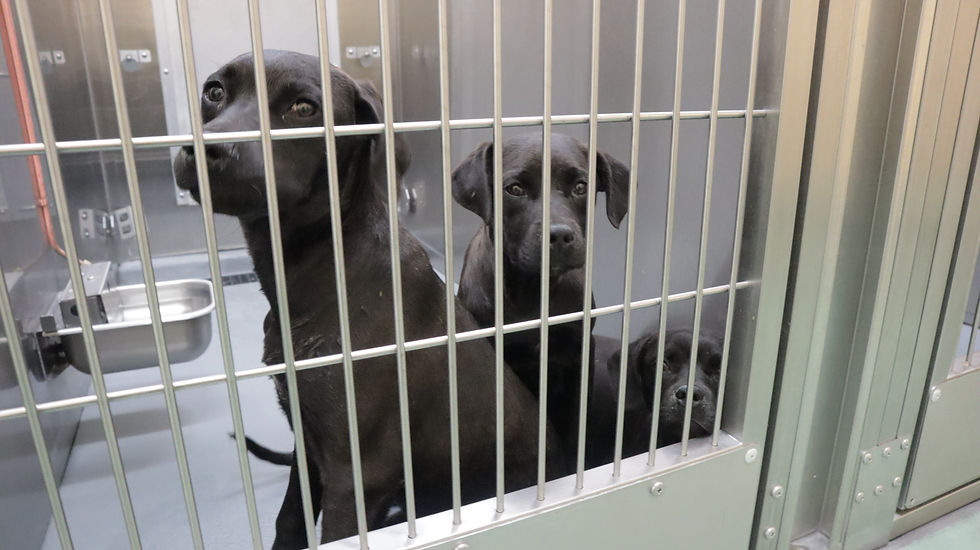
At the shelter, located off Appling Road, there is space for about 185 dogs. However, that number is the maximum. Baggot estimated the true limit to be around 120 dogs that can be comfortably housed in humane conditions. That means the dogs have kennels with a separate potty area.
Navigating capacities
The Memphis Animal Services offer medical help for sick or injured pets, provide guidance for pet owners, give shelter to strays and make sure that pets are held according to city ordinances.
Considering the number of strays in Memphis, "there is definitely a crisis”, Baggot said. As the Memphis Animal Services are a municipal open intake shelter, it is obligated to accept any pet that is brought to them. When capacities are met and there are too little adoptions, this can lead to tough decisions for their team.
"Sometimes we have to euthanize animals that are healthy and adoptable because we don’t have any space for the ones coming in. It’s literally the worst part of the job. Nobody in this building wants to do that," Baggot said.
In preparation for the cold, Animal Services tried to free as much space as possible. Via its social media, it asked the community to adopt or foster pets. Some of the posts were shared hundreds of times.

Animals rescued and save rate since 2020
In 2025, the Memphis Animal Services took in 7,813 animals. The numbers dropped: From 2022 to 2024, there were about 9,000 to nearly 10,000 animals sheltered each year. In the state of Tennessee, there is no requirement for shelters to report their data and there is also no state overview available.
Only some shelters provide data and it's difficult to compare the rates. The McKamey Animal in Chattanooga sheltered 4,820 animals last year. At the Metro Animal Care & Control – the only open-intake shelter in Nashville – there are nearly 7,000 intakes each year.
No-kill and limited intake
Beginning in 2017, the Memphis Animals Services had temporarily closed their open intake. This decision was tied to the new "No-kill" model, which is aligned with the Best Friends Animal Society. A shelter is considered "No kill," if their savings rate is 90 percent or higher.
The saving rate refers to the proportion of animals that are not killed in a shelter compared to those that are euthanized, died in care, or are lost. It is calculated by subtracting the number of animals lost (including euthanasia, deaths in care, or missing animals) from the total intake and then dividing that number by the total intake.
Therefore, the Memphis shelter had limited their stray intake to keep their savings rate up. This led to turning away owner surrenders, and, ultimately, to more strays on the streets of Memphis. Many pets were abandoned, which lead to growing stray populations.
In 2025, saving rates at the Memphis Animal Shelter dropped to 77.19 percent. This is the lowest since 2020 and the second lowest since 2016. Throughout the last ten years, the numbers have ranged up to 89.9 percent. Aside from too little adoption, outbreaks of contagious diseases like Canine Distemper often end in Euthanasia.
Throughout the last ten years, Memphis Animals Services sheltered about 9,000 strays
(cats and dogs) per year.
Save rates have stabilized at around 80% within the last ten years. Since 2020, the Memphis Animal Shelter is required to include owner requested euthanasia in the kill rate.
Animal welfare and poverty
Most of the strays live in South Memphis. People in poorer areas often keep their dogs out but don't know about spaying and neutering, Baggot said.
"There's very much a connection between human welfare and animal welfare. So, when you see a lot of poverty, you see a lot of strays and … accidental litters," Baggot said.
Another reason for the stray population here in Memphis is backyard breeding. Some financially troubled people "see animals as dollar signs," Baggot said. They breed dogs to sell them, without doing any health testing.
When backyard breeders can't find a home for their animals, they abandon them on the streets or bring them to the shelter. "It's a systemic problem in this city and a lot of it is tied to poverty," Baggot said.

Memphians and strays
For the people in these communities, it's a challenge. They don't know the strays' temperament or whether they're aggressive.
"A lot of times we pick them up and they're cute loving dogs. But living in a community where you don't feel safe sitting outside on your porch because there's dogs running around, the kids can't play outside … – it's not fair that they have to deal with that," Baggot said.
Out in the field
During the cold, Animal Control patrolled to make sure animals were safe and warm. Sometimes this leads to difficult conversations with pet owners. Field Supervisor David Johnson said community feedback is mixed.
When an officer comes to check on a pet, the first thing owners think is "…they are going to take my dog," Johnson said. However, this is not their "first option". Usually, Animal Control responds to calls suspecting there might be a neglected pet – it is their job to investigate whether this is the case.
A part of this investigation is to make sure owners are following city ordinances. Owners are required to have their dog spayed and neutered, micro-chipped and rabies-vaccinated. During this process, some people want to give up their pet as they don't feel they can take care of it anymore.
What the shelter needs
To improve the situation for both Memphians and animals, the shelter needs the help of the community, Baggot said. For example, volunteers who come in, share adoptable pets online or help at a fundraiser. But it's also money.
"I think what we really need is more funding here at the shelter … There's certain things we could be funding like pet community food centers and low cost spay and neuter," Baggot said.
Field supervisor Johnson is hoping to reach more people aside from social media. Through flyers and TV news, he wants to inform pet owners about their responsibilities. "We need to continue to educate the community," Johnson said.

Low-barrier pet ownership
The shelter's philosophy is that financial status should not be in the way of becoming a pet parent. "Animal companionship is just so important and as long as you are taking care of your animal and feeding it and loving it, you should be able to regardless of your paycheck," Baggot said.
With free pop-up vaccine clinics or free animal food, the MAS is trying to support pet parents in financial need. Its services are in great demand: At the last city-wide vaccine clinic, it offered about 500 vaccinations. By seven AM, it already reached the limit with hundreds waiting in line.
A project by Liz Preuss. Contact: lizpreuss.media@gmail.com
As cats can legally roam the streets and get adopted fast, the Memphis Animal Shelter has fewer cats
Comments