Memphis students struggle with inflation while planning their futures
By Liz Preuss, Milan Bailey and Peyton Pitts
April 6, 2026
University of Memphis students are struggling to keep up with rising gas prices, inflation and living expenses in 2026, as economic pressures push many to work more while trying to stay enrolled in college.
When U.S. President Donald Trump ran for president in 2024, he promised to make life for Americans more affordable. However, with his tariff policies and the war on Iran that began on Feb. 28, costs are adding up.
“If it gets any worse than this, then I don't know how my generation is gonna be able to power through or even afford being able to live,” Ethan Jones, a University of Memphis English major, said.
Other students expressed the same frustration with high costs that are hitting young people harder than they are the older generation.
“It made me get extra jobs because of how expensive gas is,” Rodney Shelton, a University of Memphis graduate student studying sports and leisure management, said.
Especially for young adults who are still building their careers, managing the increasing cost of living can be a challenge. With limited time and experience, they are exposed to financial shocks that can have long-lasting impacts on their futures.
As many students lack financial support and savings, they often only have a small financial net to catch them. Student Voice data from 2025 shows that unexpected expenses of $1,000 or less can seriously threaten the enrollment of 36% of students. Another 22% say unexpected expenses between $1,500 and $2,000 could force them to drop out.
Instead of schoolwork, financial stress can preoccupy students significantly. Student Voice reported that fifty percent of students say balancing academics with personal, family or financial responsibilities, including work, is a top stressor. In the worst case, it can affect their performance in college.
Here's how prices are rising…
…for gas
Graphic showing the increase in gas prices in the last year credits to Liz Preuss
After the Israeli airstrike on Iran on Feb. 28, consequences are felt worldwide. The war has led to the closure of the Strait of Hormuz, the only sea passage connecting key oil suppliers in the Persian Gulf with the world.
Guerrilla and militia groups threaten to attack passing ships, which is why carriers take more expensive detour routes around South Africa. As oil buyers worry about shortages, they have started to stock up, reducing availability and raising prices.
Data by the U.S. Energy Information Administration shows that since February 2026, gas prices have climbed from $2.809 per gallon to $3.638 in the U.S. in March 2026. This marks a rise of 25% in just one month. It's the first time in almost two years that U.S. gas prices have wandered above $3.50 per gallon.
For students, rising gas prices can be critical. A 2022 survey by Trellis Strategies found that 78% of undergraduate students reported having a car, whereas only 8% use public transportation.
Compared to that, only 16% of students live on campus, highlighting the importance of private vehicles, which makes higher gas prices a cost students can hardly avoid.

Gas prices in Arlington TN March 31, 2026 photo credits Milan Bailey
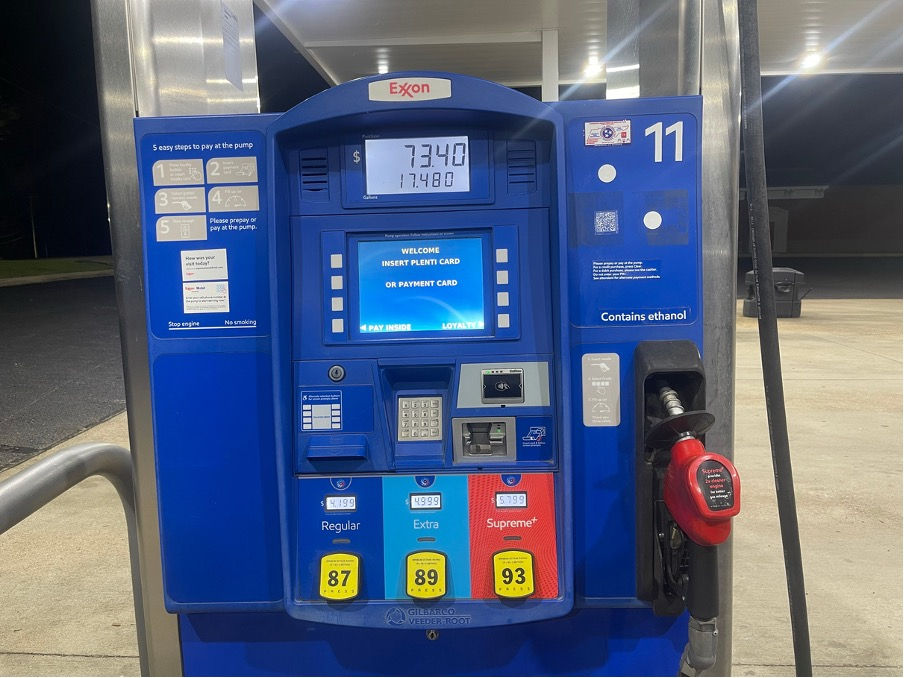
Gas prices in Arlington TN April 7, 2026 photo credits Milan Bailey
…through tariffs
Since Trump announced his new tariff policy in April 2025, countries have negotiated with the U.S. to reduce tariffs that were in some cases going up to 100%.
Although those tariffs increase tax income for the U.S., it's mostly American importers who pay the bill – sometimes passing these higher prices onto consumers. PBS reported that opposed to what Trump had announced – balancing the U.S. trading deficit and boosting manufactural business – there haven't been significant developments.
Trade deficit has shrunk by $2.1 billion, which is small compared to the total deficit of around $1 trillion annually. A boost of "Made in the USA" didn't happen either – government data shows that foreign direct investment last year was $288 billion, which is slightly less than in 2024 and below the average for the last ten years.
However, Trump's tariffs rose taxes for an average American household by 1,000$ in 2025. And it probably won't stop there, as the U.S. Tax Foundation estimates another tax plus of $600per household in 2026.
…through inflation
Another key economic pressure affecting Americans is inflation. Although price increases have slowed compared to previous years, data shows that consumer prices still rose by 2.4 percent in the year ending January 2026.
Students said they feel inflation especially through grocery costs and rent.
“It does scare me a little, because now I have to make sure that I’m ready to increase my income every day,” Shelton said.
Although costs are not rising as quickly as in previous years, they are still increasing.
…for loans
For people making large investments such as buying a house or investing in their future through college education, taking out loans can be crucial. With numbers between 3.5 to 3.75%, interest rates in the U.S. are relatively high – and not likely to lower any time soon.
The U.S. Federal Bank has once again decided to keep the rate up to further address inflation. Especially for students with loans, this can lead to financial pressure and might be a stressor to finish college as fast as possible.
Coming up with solutions
Although there is little students can change about global economics, there are ways to adjust their financial situations.
Many universities, including the University of Memphis, offer emergency financial support such as short-term loans and food pantries. However, these are often short-term solutions.
Santiago Cervantes, a University of Memphis medical student, trades stocks to pay for rent, food and school.
“Trading stocks is the only thing I knew I could make money off while I was studying 12 hours a day,” Cervantes said.
Day trading involves buying and selling stocks based on short-term price changes. While it can generate income, it also carries risk.

Braiden Cooper a University of Memphis Engineering student who DoorDashes to earn extra money photo credits to Liz Preuss
Looking into the future
With a heated political and economic situation worldwide, forecasts remain uncertain. Economic policies can take time to show their effects.
Jhoonyhung Lee, an associate economics professor at the University of Memphis, was hesitant to make predictions.
“Some positive effects in terms of governmental revenue and maybe exporters setting up plants here will take a while, so it is hard to see on a daily basis,” Lee said.
“The only way it gets better is if we can come together as a collective to stop the prices rising,” Shelton said.
Contact: Liz Preuss - lizpreuss.media@gmail.com

Comments